The current coalition Government has approved 6 major policies to pursue during its term, including more processing of mining raw materials, higher export revenue, more intensive geological surveys, prospecting and exploration, and the discovery of new deposits.
Focus on infrastructure
The 6 policies include major projects such as developing the infrastructure of national-status cities and satellite cities, and upgrading and expanding the capacity of Thermal Power Plant No. 4 and the Choibalsan thermal power plant.
Focus on mining
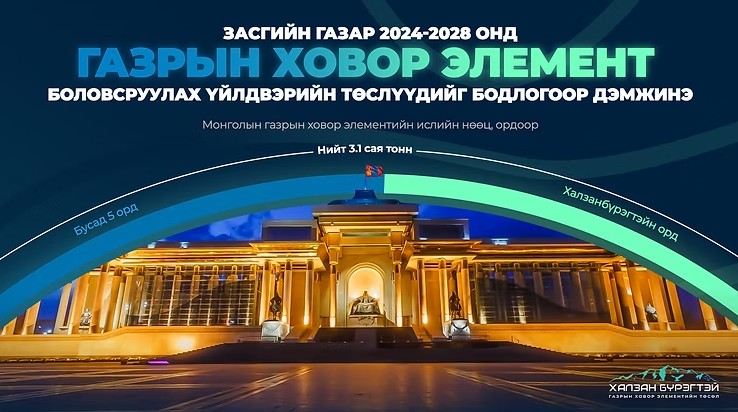
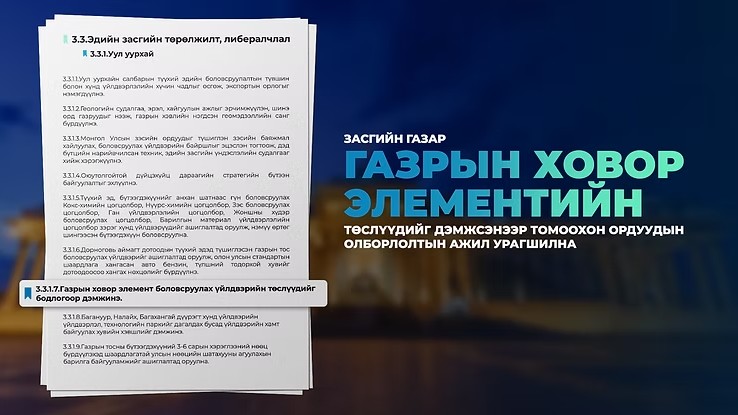
Section 3.3.1 of the Government’s policy for 2024-2028 sets out the policies and programs for the mining sector. Item 3.3.1.7 of this section states: “Rare earth element processing plant projects will be supported through policy.” This means that over the next 4 years the Government intends to enrich the country’s mineral resource base by increasing investment in rare earth elements, a raw material for high technology. This lays the groundwork for new types of projects in a mining sector that has so far focused only on coal and copper mining.
Rare earth elements: the current situation
At present, Mongolia has total rare earth oxide (REO) reserves of 3.1 million tonnes in 6 discovered deposits, 4 of them large and 2 small. The deposit with the largest reserves is the Khalzan Buregtei deposit.
Specifically, the deposit contains rare earth elements such as praseodymium, neodymium, dysprosium and terbium, which are key raw materials for high technology. They are important for renewable energy and electric vehicle manufacturing, among other uses. This means that over the next 4 years the Government will focus on increasing the economic benefits of this deposit and on implementing a processing plant project, and will pursue a policy of increasing investment.
The impact of new projects
Furthermore, if the Government steps up new types of mining projects such as rare earth elements, this will also open up opportunities such as higher export revenue and a more diversified economy. Beyond that, by supporting rare earth processing plant projects through policy, in line with the Government’s policy for the next 4 years, and by supplying the global market, Mongolia can also strengthen its position in the technology sector and expand international cooperation.
This is because, as mentioned above, elements in the deposit such as praseodymium, neodymium, dysprosium and terbium are used in high-tech manufacturing and are therefore regarded around the world as strategically important raw materials.
- They are essential for manufacturing products such as renewable energy systems, electric vehicles, batteries, wind turbines and smartphones.
- As high-value, important export products, rare earth elements will significantly increase foreign currency earnings.
- In addition, supporting rare earth projects such as Khalzan Buregtei could bring many other opportunities, including more foreign investment, the development of infrastructure and processing plants, and new jobs in local areas, especially in remote provinces.